Posts

Showing posts with the label Photosynthesis

#106 Summary of Photosynthesis

Image
1 In photosynthesis, light energy is absorbed by chlorophyll pigments and converted to chemical energy, which is used to produce complex organic molecules.  2 In the light-dependent reactions, water is split by photolysis to give hydrogen ions, electrons and oxygen. The hydrogen ions and electrons are used to reduce the carrier molecule, NADP, and the oxygen is given off as a waste product.  3 ATP is synthesised in the light-dependent reactions of cyclic and non-cyclic photophosphorylation. During these reactions the photosynthetic pigments of the chloroplast absorb light energy and give out excited electrons. Energy from the electrons is used to synthesise ATP.  4 ATP and reduced NADP are the two main products of the light-dependent reactions of photosynthesis, and they then pass to the light-independent reactions.  5 In the light-independent reactions, carbon dioxide is trapped by combination with a 5C compound, RuBP, which acts as an acceptor molecule. This reacti...
#105 Limiting factors in photosynthesis

Image
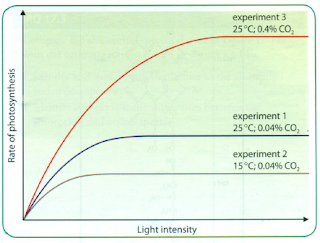
A limiting factor is a factor that controls a process. Light intensity , temperature and, CO2 concentration and availability of H2O are all factors which can control the rate of photosynthesis. Usually, only one of these factors will be the limiting factor in a plant at a certain time. This is the factor which is the furthest from its optimum level at a particular point in time. If we change the limiting factor the rate of photosynthesis will change but changes to the other factors will have no effect on the rate. If the levels of the limiting factor increase so that this factor is no longer the furthest from its optimum level, the limiting factor will change to the factor which is at that point in time, the furthest from its optimum level. For example, at night the limiting factor is likely to be the light intensity as this will be the furthest from its optimum level. During the day, the limiting factor is likely to switch to the temperature or the carbon dioxide concentration as ...

#103 The light-independent reactions (Calvin cycle)

Image
The light-independent reactions take place in the stroma of the chloroplast, where the enzyme ribulose bisphosphate carboxylase , usually known as rubisco , is found. 1. Carbon fixation CO2 diffuses into the stroma from the air spaces within the leaf. It enters the active site of rubisco , which combines it with a 5-carbon compound called ribulose bisphosphate , RuBP . The reaction is called  carbon   fixation. The products of this reaction are two 3-carbon molecules, glycerate 3-phosphate, GP . 2. Reduction  Energy from ATP and hydrogen from reduced NADP are then used to convert the GP into triose phosphate, TP . Triose phosphate is the first carbohydrate produced in photosynthesis. 3. RuBP regeneration Most of the triose phosphate is used to produce ribulose bisphosphate ( RuBP ), so that more carbon dioxide can be fixed. The rest is used to make glucose or whatever other organic substances the plant cell requires. These include: polysaccharides such as starch for...

#104 Separating chlorophyll pigments by Thin layer chromatography (TLC)

Image
Chromatography is a method of separation that relies on the different solubilities of different solutes in a solvent. A mixture of chlorophyll pigments is dissolved in a solvent, and then a small spot is placed onto chromatography paper . The solvent gradually moves up the paper, carrying the solutes with it. The more soluble the solvent, the further up the paper it is carried. Paper chromatography is a useful technique in the separation and identification of different plant pigments. In this technique, the mixture containing the pigments to be separated is first applied as a spot or a line to the paper about 1.5 cm from the bottom edge of the paper.  The paper is then placed in a container with the tip of the paper touching the solvent. Solvent is absorbed by the paper and moves up the paper by capillary action. As the solvent crosses the area containing plant pigment extract, the pigments dissolve in and move with the solvent.  The solvent carries the dissolved pigments as...

# 102 The light-dependent reactions, Photophosphorilation

Image
Chlorophyll molecules in photosystern I (PSI) and photosystern II (PSII) absorb light energy. The energy excites electrons, raising their energy level so that they leave the chlorophyll. The chlorophyll is said to be photo-activated. PSII contains an enzyme that splits water when activated by light. This reaction is called photolysis ('splitting by light'). The water molecules are split into oxygen and hydrogen atoms. Each hydrogen atom then loses its electron, to become a positively charged hydrogen ion (proton), H+. The electrons are picked up by the chlorophyll in PSII, to replace the electrons they lost. The oxygen atoms join together to form oxygen molecules, which diffuse out of the chloroplast and into the air around the leaf. The light- dependent reactions. Credit: Pears education.  The electrons emitted from PSII are picked up by electron carriers in the membranes of the thylakoids. They are passed along a chain of these carriers, losing energy as they go. The energy ...

#99 Photosynthesis overview

Image
Photosynthesis is a series of reactions in which energy transferred as light is transformed to chemical energy. Energy from light is trapped by chlorophyll, and this energy is then used to • split apart the strong bonds in water molecules to release hydrogen • produce ATP • reduce a substance called NADP. NADP stands for nicotinamide adenine dinucleotide phosphate, which - like NAD - is a coenzyme. The ATP and reduced NADP are then used to add hydrogen to carbon dioxide , to produce carbohydrate molecules such as glucose . These complex organic molecules contain some of the energy that was originally in the light. The oxygen from the split water molecules is a waste product, and is released into the air. There are three basic steps in photosynthesis: 1.   Light- dependent reactions   - energy capture     chemiosmosis generation of ATP (adenosine triphosphate) from harvested sunlight 2. Light-independent reactions  - fixation of carbon     enzyme cat...

#98 Photosynthesis Syllabus

13.1   Photosynthesis as an energy transfer process 13.2  Investigation of limiting factors 13.3  Adaptations for photosynthesis Photosynthesis is the energy transfer process that  is the basis  of much  of life on Earth. It provides the basis  of most food chains  providing energy directly or indirectly for all other  organisms. In eukaryotes, the process occurs within chloroplasts. Candidates use  their knowledge of plant cells and leaf structure from the section on Cell structure while studying photosynthesis. Various environmental factors influence the rate  at which photosynthesis occurs. Candidates will be expected to use  the knowledge gained  in this section to solve problems in familiar and unfamiliar contexts. Learning outcomes Candidates should  be able to: 13.1  Photosynthesis as an energy transfer process Light energy absorbed by chloroplast pigments in the light dependent stage of photosynthesis is ...